Thursday, 3 July 2014

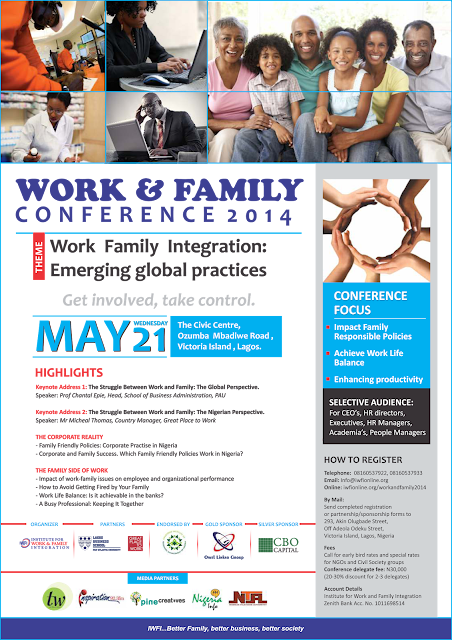
Inaugural Edition of the IWFI Work and Family Conference at the Civic Centre Lagos

The institute of Work and Family Integration (IWFI) in collaboration with Lagos Business School and Great Place to Work, on Wednesday the 21st of May, organized a conference on emerging global practices, with respect to work and family life balance. It was endorsed by the Chattered Institute of Personnel Management.

The occasion kicked off with the chairman, Engr. Charles Osezua OON KSG, opening address. Executives drawn from the academic, banking and corporate world facilitated the conference. The forum provided a platform for HR executives, employers of labor and employees to advance Family friendly policies within the work environment. In addition, corporate practices being practiced by different establishments both within and outside Nigeria were sited.

The main focus of the conference was to achieve impactful family responsible policies, work life balance and enhance productivity in the work place. To effectively deliver the conference objectives, an address titled, The Struggle between Work and family: The Global Perspective, was delivered by Professor Chantal Epie of the prestigious Lagos Business School, LBS. This was followed by another keynote address titled The Struggle between Work and Family: The Nigerian perspective, delivered by Mr. Michael Thomas, country manager of Great Place to Work.

The corporate reality focus of the conference was treated by means of topics such as Family friendly Policies, corporate practices in Nigeria, and Corporate and Family Success: Which Family Friendly Policies work in Nigeria? HR directors of Akintola Williams Deliotte, NSIA insurance and Fidelity Bank shared with the smart audience the family responsible policies which are operational in their companies and how it has enhanced productivity and organizational performance.

The family side of work was not left unattended to. Impact of work-family issues on employee and organizational performance, How to avoid being fired by Your Family, Work Life Balance: Is it achievable in the banks? Cultural aspects in Work-Life balance: the Human being in the worker., were all topical avenues explored to achieve the set goals. Some of the distinguished speakers were Dr. Christiane Spitzmueller, Associate Professor , University of Houston, Texas, Mr. Soni Irabor, MD/CEO, Inspiration 92.3 fm, Sir. Orji Udumezue, professional banker and finance Consultant and Diane Lemiueux.

The sections were chaired by notable personalities like Professor Albert Alos, Pan-Atlantic University and Mr. Femi Mokikan, HR Executive Director of 7UP Company and Sir. Chris Ogbechie of the Lagos Business School.

The Institute for Work Family Integration is an NGO concerned with providing solutions for the challenges occasioned by demographic shifts in the work place and technological changes in society for a fulfilled family life and enhanced productivity.

SEE PHOTOS

This event had Owel Linkso Group, CBO Capital, Zenith bank, Nest Oil, Coca Cola and PZ cussons as sponsors. Nigeria info, Inspiration 92.3fm, Jemima and tw magazine were media sponsors of this event.

OBSERVATIONS
1. Unrealistic work demands
2. Limited or no rest opportunities
3. Traffic situation
4. Absentee parenting
5. Work life balance is not a quick fix short term solution. It is a life- long aspiration.
6. Work life balance solutions cannot be the same across board.
RECOMMENDATIONS
1. Comprehensive medical coverage for the family
2. Conducive work environment
3. Post-work life support
4. Incentives (End of year profit sharing)
5. Professionals are advised to get healthy hobbies that energizes your spirits
6. Bonding/recreational activities

by Nehizena Imade

Wednesday, 2 July 2014

Non Profit Management In an Interconnected World

NGOs require information and professionalism to actualize their objectives in such an interconnected world. They are task-oriented and driven by people with a common interest. They perform a variety of welfare services and humanitarian functions; bring citizen concerns to governments, advocate and monitor policies .They also encourage political participation through provision of information.

In Nigeria, they can play a pivotal role in the provision of grassroots economic development, health care information, Employee infrastructural development, human welfare services, environmental degradation prevention, civil rights protection and a lot of other issues left unattended to by the government.

Considering their potential roles in every economy, it is imperative for NGOs to be well informed, ethical and professional in their dealings. According to UNEP-International Environment Technology Centre, this process starts from within the organization through avenues such as; building credibility, transparency and accountability and ultimately, trust with the people and organizations that they partner with.

In order to reinforce its belief in professionalism, the team at IWFI had the privilege to participate in a training titled ‘Non-profit Management in an interconnected world’. It was organized by Intermedia consulting, and it addressed the required skills as representatives of the Institute for Work and Family Integration (IWFI) to professionally manage and increase its positive social impact. The training was attended by some other NGOs including: :
i)Fertility Care Centers of Africa (FCCAF)
ii) M. L. E. foundation
iii) Happy Home Foundation
iv)Good Living Initiative
v) ECS (Educational Cooperation Society)
VI) Nigerian Association for Family Development (NAFAD)
vii) Organization for Character Education for Teens, Singles and Married (OCETSMA)

New skills in personality and styles of leadership were taught. We got to understand that fundraising is not begging for money but a noble contribution that is made by donors to the community. As an NGO we sometimes help donors to channel their resources towards noble courses that benefits society. The session on Social Media engagement was very well received. It posed a challenge to many of the participants while trying to reconcile the fact that digital technology is part of our world and for us to move beyond our four walls, we need to utilize social media. The passionate presenter, Mrs. Faith Oyepeju, showed us the power of social media and its multiplier effect. Participants were urged not to be overwhelmed as it may have shown on the facial expressions, but to embrace social media and start incorporating it in the running of our organization. There was a practical Social Media workshop which aided many to accept the challenge and make our NGO’s social media compliant.

Managing the Media and making them our friends was a session that practically showed how NGOs can increase their reach through media. Surprisingly enough, by making ourselves news worthy, we could get media coverage without significant financial expenditure. We learnt about the qualities of news worthy items, and never to underestimate the power of relationship building and maintaining them. This session was delivered by experienced seasoned practitioners in the field.Martins Udogie, a radio presenter (Fidelity SME program on Inspiration FM) and Felix Iwuagwu, a former News producer with the NTA. They encouraged us to position ourselves in the media in order to increase the reach to our target audience and beyond. Other sessions of the training highlighted the need to master the use of persuasive communication by Dr. Eugene Ohu of the Lagos Business School, the Legal aspect of non-profit management by Barr. Sonnie Ekwowusie and Non-Profit internal and external issues by Mrs. Theresa Okafor of Qaardan.

Finally, there was a Case study that helped us learn to always keep in perspective our organization’s objectives. We also realized the need to periodically perform a SWOT analysis of our organizations and at the same time endeavor to be financially sustainable but not at the expense our main objectives. Most participants requested for this training to be an annual programme with newer modules while advancing on modules already taught.

by Anne Osezua and Callistus Dike

Breadwinning Mothers, Then and Now by Sarah Jane Glynn

The movement of women out of the home and into the paid labor force has changed the way families live and work today. The role of working mothers as breadwinners has received increased media and scholarly attention since the Center for American Progress first released “The New Breadwinners,” a chapter in 2009’s The Shriver Report: A Woman’s Nation Changes Everything. Through groundbreaking research, economist Heather Boushey empirically illustrated how women’s labor-force participation has grown dramatically over the past 50 years and that mothers are more likely to provide significant financial support to their families than ever before.

In this report, we update Boushey’s analysis using the most recent data available on the status of working mothers as breadwinners or co-breadwinners. We offer new insights into the demographics of mothers whose earnings help keep their families afloat. We find that the trends first identified in “The New Breadwinners” remain in effect but that breadwinning mothers are not all cut from the same cloth. We compare mothers who are single breadwinners, married breadwinners, married co-breadwinners, and married with no earnings along a number of demographics in order to better understand the patterns and context within which mothers combine wage earning with caregiving. We find notable differences among the groups in terms of family income, race and ethnicity, educational attainment, age, and the age of the youngest child.

Despite these nuances and differences, one striking fact remains: The days of the full-time, stay-at-home mom are long in the past for most families, and there is no indication that patterns will revert back to those of the 1960s. The fact that so many women are economically responsible for themselves and their families shows how far women have come in terms of education, career advancement, and their own economic independence. But we still have a long way to go.

Programs that would provide universal access to workplace policies such as paid sick days and paid family and medical leave would help ensure that working mothers have the necessary tools to support their families economically while still being able to provide care. Passing legislation such as the Family and Medical Insurance Leave Act, or FAMILY Act—which would create a federal paid family and medical leave social insurance program—and the Healthy Families Act—which would guarantee workers the right to accrue paid sick days—would be an important way to begin updating our labor standards for the 21st century.

Understanding who breadwinning mothers are and what their families look like is an important first step to work toward a better future, one in which our policies align with the lives of working families.

Sarah Jane Glynn is Associate Director for Women’s Economic Policy at the Center for American Progress.

Monday, 16 June 2014

IWFI POST CONFERENCE APPRECIATION COCKTAIL

Feeling gratitude and not expressing it is like wrapping a present and not giving it.(William Arthur Ward)

Tuesday evening,June 10 Pan-Atlantic University, marked an epoch making event in the history of IWFI. All collaborators, friends and partners of the institute were hosted to an appreciation cocktail. It was to say thank you to everyone.

It is remarkable to know that we have such great people in Nigeria supporting Work and Family Integration which is essential to a healthy and productive society.

Guests include Dean of the Lagos Business School, Dr. Enase Okonedo, MD of CBO Capital Chuka Mordi, Nike Ademiju of Deloitte, Napoleon Esedmudje of Fidelity Bank,Sir Orji Udemezue, a Trainer/Consultant. Others were the team from Nigeria Info, Great places to work, IBM, School of Media and Communication, Owel-Linkso Group, and Etisalat.

by Callistus Dike

Monday, 5 May 2014

Work and Family Conference 2014, May 21st Civic Centre, Lagos.

Join policy makers, HR executives, industry experts and world leaders to discover recent trends in work- family friendly policies around the world and which ones work in Nigeria. Call 08160537922, 08160537933


http://www.iwfionline.org/workandfamily2014/


Saturday, 3 May 2014

Work -Life Balance Initiatives

Over the years, individuals have experienced major conflicts in different aspects of life, especially between work and family which have resulted to important socio-demographic changes such as - a large number of women in the labor market, increased rate of divorce and as well the number of single -parent families. Health problems like stress and depression have also increased (Nuria Chinchilia and Elizabeth Torres).

In recent times, people seek jobs that offer not just financial security, but also have autonomy, meaning and the opportunity for development and advancement. They also want time to pursue personal interests and enjoy time outside of the workplace.

Balancing responsibilities for work, family, education and other commitments is becoming increasingly difficult under traditional work schedules. While some employers are committed to creating a supportive, flexible work environment as well as providing benefits and services that help staff in their lives outside of work, others still do not take into account these changes in the way they organize and manage their workforce.

Adopting Work-life initiatives provide benefits not just for an employee; it is also an important consideration for organizations seeking to improve their organizational effectiveness. These are policies, programs and work practices designed to facilitate the integration of work and non-work domains. These initiatives usually take the form of flexible work options, family or personal leave, and organizational assistance with childcare. Others are employee assistance programs, on-site seminars and workshops (on such topics as stress, nutrition, smoking, communication etc),internal and/or external educational or training opportunities, fitness facilities, or fitness membership assistance.(Canadian Centre for Occupational Health and Safety)

For an organization, a carefully implemented work life initiative will provide specific benefits such as an improved morale of the employees, improved working relationships, increased level of production and satisfaction, attracting new employees, helping to retain staff, building diversity in skills and personnel, improving morale, reducing sickness and absenteeism, enhancing working relationships between colleagues, encouraging employees to show more initiative and teamwork, increasing levels of production and satisfaction, and decreasing stress and burn-out.(Canadian Centre for Occupational Health and Safety).

However, each workplace should tailor its work/life policies to suit their own particular needs and corporate culture. An evaluation or feedback systems should also be part of that process.

What organisations in Nigeria are doing(GSK Nigeria)

At the IWFI Society and Technology Conference 2013, the following list was presented by Professor Chantal Epie of the Lagos Business School in a paper titled 'Work Family Policies and Practices' using GSK Nigeria as case study
•Staggered work hours
•Flexibility of leave and short vacation
•5 days’ paternity leave
•Maternity leave: 3 months + reduced work days for another 3 months + possibility of 10 more days of absence in the course of 12 months after returning to work + possibility of a month of unpaid leave
•Possibility of a career break from 1 month to 2 years
•The company is studying the possibility of setting up a child care unit for children of staff
•Practice (not policy): senior managers can sometimes work from home
•Gym; cafeteria, breaker rooms; table tennis

by Callistus Dike
cally352002@yahoo.com

Friday, 28 March 2014

Digital environments that aid relationships and makes family grow

Recent trends in technology have increasingly brought about the erosion of boundaries between the physical and digital worlds; a convergence which implies connecting a large and varied range of physical elements to the digital world. A lot of benefits capable of bringing improvement in people's lives can be derived from such a world without boundaries. Bringing about greater efficiency and lots of new opportunities. However, creating value in such an environment would rely greatly on building relationships between people and information. In other words getting things connected. Sherry Turkle says, we have come to expect more in terms of relationships from machines and less from each other. We rely on technology to find friendship and trust while spending so much time getting connected.
The realization is that being connected, we are
actually disconnected - from our friends, families and environment.

an intelligent use of technology holds the key to achieving a sustainable society.”


We find friends put on the television which disrupts our conversations during a visit, at meetings heads are bowed down with hands texting away, kids stay glued all day to their video games not wanting to study, motorists are making and receiving phone calls while driving, on the streets, in the classrooms, at dinner, people avoid conversations by texting on their phones. Isn't it true that our use of technology just might be taking control over our lives and destroying our relationships?
It is pertinent to ponder how much true and genuine interactions we can create with the people around us who can bring real meaning into our lives. Advancement in technology and being in touch with a lot of people does not imply an improved quality of relationships. “The more intense the shared meaning, the greater the quality of human interaction attained “- Dr. Eugene Ohu, SOCTECH 2013. One of the benefits of spending quality time (devoid of interruptions from technological devices) in the family is that children learn how to interact with other people, how to communicate and how to show real-life empathy. Else, parents find themselves raising children who cannot relate to other people because, due to their unrestricted use of technological devices, they do not have enough interpersonal face-to-face interaction needed to develop proper social skills.
Technology provides diffusion of knowledge but rumors easily spread, it provides access to information but information become scattered, it provides avenue for engagement but there is lack of attention, it provides simplicity and efficiency but the result can be lack of productivity, it gets us closer to celebrities but far from the those near us, it provides transparency but with a sharing of intimacy, with technology you are always on but you get online addiction, you find identity but could be a strategic profile – Prof. Perez Latre, SOCTECH 2013. Besides these social and psychological effects, other risks like harmful advice, online harassment, illegal interaction, illegal contents, cyberbullying, and identity theft are directly associated with the use of online technologies. Some advice for avoiding these types of risk includes using firewalls and intrusion detection softwares, using a website reputation service to quickly check if the url is safe to visit, providing personal information only when the websites displays a locked icon(means it is secure)at the bottom of your browser,using a password that would be difficult for someone to guess and change it regularly,learning about a site’s privacy and security policies, knowing what is appropriate to share on social networking sites .... It suffices to say that an intelligent use of technology holds the key to achieving a sustainable society. The idea is not to abandon technology which truly can improve our lives but that while taking advantage of the benefits technology offers, we should be mindful of its downfalls. To this end we must adopt measures and good practices that will ensure we live in the kind of digital environments that can help our relationships and our families grow.

by Callistus Dike
cally352002@yahoo.com