The movement of women out of the home and into the paid labor force has changed the way families live and work today. The role of working mothers as breadwinners has received increased media and scholarly attention since the Center for American Progress first released “The New Breadwinners,” a chapter in 2009’s The Shriver Report: A Woman’s Nation Changes Everything. Through groundbreaking research, economist Heather Boushey empirically illustrated how women’s labor-force participation has grown dramatically over the past 50 years and that mothers are more likely to provide significant financial support to their families than ever before.
In this report, we update Boushey’s analysis using the most recent data available on the status of working mothers as breadwinners or co-breadwinners. We offer new insights into the demographics of mothers whose earnings help keep their families afloat. We find that the trends first identified in “The New Breadwinners” remain in effect but that breadwinning mothers are not all cut from the same cloth. We compare mothers who are single breadwinners, married breadwinners, married co-breadwinners, and married with no earnings along a number of demographics in order to better understand the patterns and context within which mothers combine wage earning with caregiving. We find notable differences among the groups in terms of family income, race and ethnicity, educational attainment, age, and the age of the youngest child. Despite these nuances and differences, one striking fact remains: The days of the full-time, stay-at-home mom are long in the past for most families, and there is no indication that patterns will revert back to those of the 1960s. The fact that so many women are economically responsible for themselves and their families shows how far women have come in terms of education, career advancement, and their own economic independence. But we still have a long way to go. Programs that would provide universal access to workplace policies such as paid sick days and paid family and medical leave would help ensure that working mothers have the necessary tools to support their families economically while still being able to provide care. Passing legislation such as the Family and Medical Insurance Leave Act, or FAMILY Act—which would create a federal paid family and medical leave social insurance program—and the Healthy Families Act—which would guarantee workers the right to accrue paid sick days—would be an important way to begin updating our labor standards for the 21st century. Understanding who breadwinning mothers are and what their families look like is an important first step to work toward a better future, one in which our policies align with the lives of working families. Sarah Jane Glynn is Associate Director for Women’s Economic Policy at the Center for American Progress.Wednesday, 2 July 2014
Monday, 16 June 2014
IWFI POST CONFERENCE APPRECIATION COCKTAIL
Feeling gratitude and not expressing it is like wrapping a present and not giving it.(William Arthur Ward)
Tuesday evening,June 10 Pan-Atlantic University, marked an epoch making event in the history of IWFI. All collaborators, friends and partners of the institute were hosted to an appreciation cocktail. It was to say thank you to everyone. It is remarkable to know that we have such great people in Nigeria supporting Work and Family Integration which is essential to a healthy and productive society. Guests include Dean of the Lagos Business School, Dr. Enase Okonedo, MD of CBO Capital Chuka Mordi, Nike Ademiju of Deloitte, Napoleon Esedmudje of Fidelity Bank,Sir Orji Udemezue, a Trainer/Consultant. Others were the team from Nigeria Info, Great places to work, IBM, School of Media and Communication, Owel-Linkso Group, and Etisalat. by Callistus DikeMonday, 5 May 2014
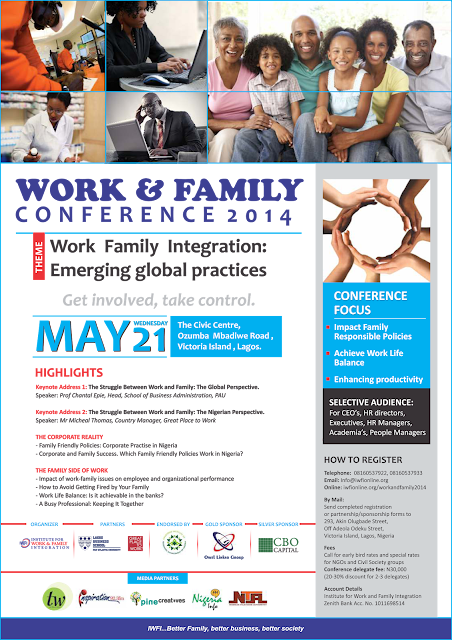
Work and Family Conference 2014, May 21st Civic Centre, Lagos.
Join policy makers, HR executives, industry experts and world leaders to discover recent trends in work- family friendly policies around the world and which ones work in Nigeria. Call 08160537922, 08160537933
Saturday, 3 May 2014
Work -Life Balance Initiatives
Over the years, individuals have experienced major conflicts in different aspects of life, especially between work and family which have resulted to important socio-demographic changes such as - a large number of women in the labor market, increased rate of divorce and as well the number of single -parent families. Health problems like stress and depression have also increased (Nuria Chinchilia and Elizabeth Torres).
In recent times, people seek jobs that offer not just financial security, but also have autonomy, meaning and the opportunity for development and advancement. They also want time to pursue personal interests and enjoy time outside of the workplace.
Balancing responsibilities for work, family, education and other commitments is becoming increasingly difficult under traditional work schedules. While some employers are committed to creating a supportive, flexible work environment as well as providing benefits and services that help staff in their lives outside of work, others still do not take into account these changes in the way they organize and manage their workforce.
Adopting Work-life initiatives provide benefits not just for an employee; it is also an important consideration for organizations seeking to improve their organizational effectiveness. These are policies, programs and work practices designed to facilitate the integration of work and non-work domains. These initiatives usually take the form of flexible work options, family or personal leave, and organizational assistance with childcare. Others are employee assistance programs, on-site seminars and workshops (on such topics as stress, nutrition, smoking, communication etc),internal and/or external educational or training opportunities, fitness facilities, or fitness membership assistance.(Canadian Centre for Occupational Health and Safety)
For an organization, a carefully implemented work life initiative will provide specific benefits such as an improved morale of the employees, improved working relationships, increased level of production and satisfaction, attracting new employees, helping to retain staff, building diversity in skills and personnel, improving morale, reducing sickness and absenteeism, enhancing working relationships between colleagues, encouraging employees to show more initiative and teamwork, increasing levels of production and satisfaction, and decreasing stress and burn-out.(Canadian Centre for Occupational Health and Safety).
However, each workplace should tailor its work/life policies to suit their own particular needs and corporate culture. An evaluation or feedback systems should also be part of that process.
What organisations in Nigeria are doing(GSK Nigeria)
At the IWFI Society and Technology Conference 2013, the following list was presented by Professor Chantal Epie of the Lagos Business School in a paper titled 'Work Family Policies and Practices' using GSK Nigeria as case study
•Staggered work hours
•Flexibility of leave and short vacation
•5 days’ paternity leave
•Maternity leave: 3 months + reduced work days for another 3 months + possibility of 10 more days of absence in the course of 12 months after returning to work + possibility of a month of unpaid leave
•Possibility of a career break from 1 month to 2 years
•The company is studying the possibility of setting up a child care unit for children of staff
•Practice (not policy): senior managers can sometimes work from home
•Gym; cafeteria, breaker rooms; table tennis
by Callistus Dike
cally352002@yahoo.com
In recent times, people seek jobs that offer not just financial security, but also have autonomy, meaning and the opportunity for development and advancement. They also want time to pursue personal interests and enjoy time outside of the workplace.
Balancing responsibilities for work, family, education and other commitments is becoming increasingly difficult under traditional work schedules. While some employers are committed to creating a supportive, flexible work environment as well as providing benefits and services that help staff in their lives outside of work, others still do not take into account these changes in the way they organize and manage their workforce.
Adopting Work-life initiatives provide benefits not just for an employee; it is also an important consideration for organizations seeking to improve their organizational effectiveness. These are policies, programs and work practices designed to facilitate the integration of work and non-work domains. These initiatives usually take the form of flexible work options, family or personal leave, and organizational assistance with childcare. Others are employee assistance programs, on-site seminars and workshops (on such topics as stress, nutrition, smoking, communication etc),internal and/or external educational or training opportunities, fitness facilities, or fitness membership assistance.(Canadian Centre for Occupational Health and Safety)
For an organization, a carefully implemented work life initiative will provide specific benefits such as an improved morale of the employees, improved working relationships, increased level of production and satisfaction, attracting new employees, helping to retain staff, building diversity in skills and personnel, improving morale, reducing sickness and absenteeism, enhancing working relationships between colleagues, encouraging employees to show more initiative and teamwork, increasing levels of production and satisfaction, and decreasing stress and burn-out.(Canadian Centre for Occupational Health and Safety).
However, each workplace should tailor its work/life policies to suit their own particular needs and corporate culture. An evaluation or feedback systems should also be part of that process.
What organisations in Nigeria are doing(GSK Nigeria)
At the IWFI Society and Technology Conference 2013, the following list was presented by Professor Chantal Epie of the Lagos Business School in a paper titled 'Work Family Policies and Practices' using GSK Nigeria as case study
•Staggered work hours
•Flexibility of leave and short vacation
•5 days’ paternity leave
•Maternity leave: 3 months + reduced work days for another 3 months + possibility of 10 more days of absence in the course of 12 months after returning to work + possibility of a month of unpaid leave
•Possibility of a career break from 1 month to 2 years
•The company is studying the possibility of setting up a child care unit for children of staff
•Practice (not policy): senior managers can sometimes work from home
•Gym; cafeteria, breaker rooms; table tennis
by Callistus Dike
cally352002@yahoo.com
Friday, 28 March 2014
Digital environments that aid relationships and makes family grow
Recent trends in technology have increasingly brought about the erosion of boundaries between the physical and digital worlds; a convergence which implies connecting a large and varied range of physical elements to the digital world.
A lot of benefits capable of bringing improvement in people's lives can be derived from such a world without boundaries. Bringing about greater efficiency and lots of new opportunities.
However, creating value in such an environment would rely greatly on building relationships between people and information. In other words getting things connected. Sherry Turkle says, we have come to expect more in terms of relationships from machines and less from each other. We rely on technology to find friendship and trust while spending so much time getting connected.
We find friends put on the television which disrupts our conversations during a visit, at meetings heads are bowed down with hands texting away, kids stay glued all day to their video games not wanting to study, motorists are making and receiving phone calls while driving, on the streets, in the classrooms, at dinner, people avoid conversations by texting on their phones. Isn't it true that our use of technology just might be taking control over our lives and destroying our relationships?
It is pertinent to ponder how much true and genuine interactions we can create with the people around us who can bring real meaning into our lives. Advancement in technology and being in touch with a lot of people does not imply an improved quality of relationships. “The more intense the shared meaning, the greater the quality of human interaction attained “- Dr. Eugene Ohu, SOCTECH 2013. One of the benefits of spending quality time (devoid of interruptions from technological devices) in the family is that children learn how to interact with other people, how to communicate and how to show real-life empathy. Else, parents find themselves raising children who cannot relate to other people because, due to their unrestricted use of technological devices, they do not have enough interpersonal face-to-face interaction needed to develop proper social skills.
Technology provides diffusion of knowledge but rumors easily spread, it provides access to information but information become scattered, it provides avenue for engagement but there is lack of attention, it provides simplicity and efficiency but the result can be lack of productivity, it gets us closer to celebrities but far from the those near us, it provides transparency but with a sharing of intimacy, with technology you are always on but you get online addiction, you find identity but could be a strategic profile – Prof. Perez Latre, SOCTECH 2013. Besides these social and psychological effects, other risks like harmful advice, online harassment, illegal interaction, illegal contents, cyberbullying, and identity theft are directly associated with the use of online technologies. Some advice for avoiding these types of risk includes using firewalls and intrusion detection softwares, using a website reputation service to quickly check if the url is safe to visit, providing personal information only when the websites displays a locked icon(means it is secure)at the bottom of your browser,using a password that would be difficult for someone to guess and change it regularly,learning about a site’s privacy and security policies, knowing what is appropriate to share on social networking sites .... It suffices to say that an intelligent use of technology holds the key to achieving a sustainable society. The idea is not to abandon technology which truly can improve our lives but that while taking advantage of the benefits technology offers, we should be mindful of its downfalls. To this end we must adopt measures and good practices that will ensure we live in the kind of digital environments that can help our relationships and our families grow.
by Callistus Dike
cally352002@yahoo.com
| The realization is that being connected, we are actually disconnected - from our friends, families and environment. |
“an intelligent use of technology holds the key to achieving a sustainable society.”
|
We find friends put on the television which disrupts our conversations during a visit, at meetings heads are bowed down with hands texting away, kids stay glued all day to their video games not wanting to study, motorists are making and receiving phone calls while driving, on the streets, in the classrooms, at dinner, people avoid conversations by texting on their phones. Isn't it true that our use of technology just might be taking control over our lives and destroying our relationships?
It is pertinent to ponder how much true and genuine interactions we can create with the people around us who can bring real meaning into our lives. Advancement in technology and being in touch with a lot of people does not imply an improved quality of relationships. “The more intense the shared meaning, the greater the quality of human interaction attained “- Dr. Eugene Ohu, SOCTECH 2013. One of the benefits of spending quality time (devoid of interruptions from technological devices) in the family is that children learn how to interact with other people, how to communicate and how to show real-life empathy. Else, parents find themselves raising children who cannot relate to other people because, due to their unrestricted use of technological devices, they do not have enough interpersonal face-to-face interaction needed to develop proper social skills.
Technology provides diffusion of knowledge but rumors easily spread, it provides access to information but information become scattered, it provides avenue for engagement but there is lack of attention, it provides simplicity and efficiency but the result can be lack of productivity, it gets us closer to celebrities but far from the those near us, it provides transparency but with a sharing of intimacy, with technology you are always on but you get online addiction, you find identity but could be a strategic profile – Prof. Perez Latre, SOCTECH 2013. Besides these social and psychological effects, other risks like harmful advice, online harassment, illegal interaction, illegal contents, cyberbullying, and identity theft are directly associated with the use of online technologies. Some advice for avoiding these types of risk includes using firewalls and intrusion detection softwares, using a website reputation service to quickly check if the url is safe to visit, providing personal information only when the websites displays a locked icon(means it is secure)at the bottom of your browser,using a password that would be difficult for someone to guess and change it regularly,learning about a site’s privacy and security policies, knowing what is appropriate to share on social networking sites .... It suffices to say that an intelligent use of technology holds the key to achieving a sustainable society. The idea is not to abandon technology which truly can improve our lives but that while taking advantage of the benefits technology offers, we should be mindful of its downfalls. To this end we must adopt measures and good practices that will ensure we live in the kind of digital environments that can help our relationships and our families grow.
by Callistus Dike
cally352002@yahoo.com
Friday, 7 March 2014
SUPPORTING THE BEDROCK OF SOCIETY
Part of the objective for the 20th anniversary celebration of the United Nations for the year of the family is to consider trends in family policy development and to share good practices. A lot of challenges and implications are the results of policies that affect the state of the family.
The family is very important to society such that the strength, health and resilience of a nation fundamentally depend on how well families function.
Michael Novak states in his commentary on the family: ‘Clearly, the family is the seedbed of economic skills, money habits, attitudes toward work, and the arts of financial independence.
The family is a stronger agency of educational success than the school. The family is a stronger teacher of the religious imagination than the church. Political and social planning in a wise social order begins with the axiom; 'what strengthens the family strengthens society’….
Public policies that support family issues such as housing, transport, infrastructure, health, education, taxation, employment and disability services can help to balance the demands between work and family while paid leave, childcare and support for housing are positively related to both job satisfaction and organizational commitment. It is important to make efforts towards reducing the negative effects between work and family in organizations to improve productivity of employed parents.
At IWFI, we join in the discussions as we examine global trends from world leaders and industry experts on how family responsible policies are implemented at various spheres of economy and in organizations. On the 21st of May, we shall have a select group of CEOs, senior executives, HR directors and principals of industry in Lagos at the IWFI Work and Family Conference to identify work and family best practices, case studies, solutions and recommendations.
You can find out how to participate by calling Anne 08160537922 or Charles 08160537933
Monday, 3 March 2014
SECOND IWFI MARRIED COUPLES RETREAT - A MEMORABLE WEEKEND FOR US
The weekend of 21 to 23 Feb. 2014 will go down memory lane in our marital history. It was the second edition of the IWFI married couples retreat at the prestigious Epe Resort & Spa, Epe. My wife and I had the opportunity to participate alongside other couples. We learnt as much as we had fun.
To help couples strengthen and enrich their relationship, based on the understanding that people with better married lives are better adjusted and make better employees, the Institute for Work and Family Integration(IWFI) have designed this weekend retreat to help couples understand themselves, their spouse and rediscover true love.
Want to know why you act the way you do? Sure we did, after the first discussion on temperaments. It was quite revealing, we got to understand better our reactions to issues. The presentation got us laughing most of the time, apparently as we began our journey towards self discovery and strengthening our relationship.
Set in the serene and tranquil environment of the resort, we were engaged in exercises that required private dialogue in our rooms after class discussions. Movie clips gave insight to the virtues being discussed. These private dialogues sometimes carried on beyond the allotted time as it seemed, couples did have a lot to talk about. Indeed we were meant to ‘rediscover’ true love as we sat and did things as couples. It would seem odd to find one of the spouses alone. Use of Mobile phones and Television was discouraged to prevent distraction. It was like it stated in one of the promotional materials – rejuvenating!
I can not remember the last time I rode on a bike. Well, I got my chance (yeah with a little help!).
It was social activity time that got us all sweating; a variety of sports including volleyball, swimming, table tennis, lawn tennis, basket ball was available. It was funny watching my wife play table tennis (with that bulging stomach) .I was impressed because i didn’t know she could do it.
Every time I walk into the cozy restaurant, the aroma of food always reminds me of how hungry I am. The food quite tasty, had international and traditional dishes beckoning on us. The rich menu and the professional and courteous restaurant staff, made our meal times a sumptuous experience.
The ‘champagne popping moment’ (well, something like that after the last class session) was one of the highlights of the weekend. Then our chief facilitators Engr. Charles Osezua and Mrs. Gloria Osezua shared their life experiences after thirty eight years of marriage. It was awesome listening to how they have made it work over the years. I am yet to experience an informative, workshop-like, yet relaxing and romantic session like the IWFI married couples retreat. Our married friends have to know about this.There are innumerable benefits to be achieved. My wife and I had a life changing experience and our love has had a new meaning after that weekend.
Set in the serene and tranquil environment of the resort, we were engaged in exercises that required private dialogue in our rooms after class discussions. Movie clips gave insight to the virtues being discussed. These private dialogues sometimes carried on beyond the allotted time as it seemed, couples did have a lot to talk about. Indeed we were meant to ‘rediscover’ true love as we sat and did things as couples. It would seem odd to find one of the spouses alone. Use of Mobile phones and Television was discouraged to prevent distraction. It was like it stated in one of the promotional materials – rejuvenating!
I can not remember the last time I rode on a bike. Well, I got my chance (yeah with a little help!).
It was social activity time that got us all sweating; a variety of sports including volleyball, swimming, table tennis, lawn tennis, basket ball was available. It was funny watching my wife play table tennis (with that bulging stomach) .I was impressed because i didn’t know she could do it.
Every time I walk into the cozy restaurant, the aroma of food always reminds me of how hungry I am. The food quite tasty, had international and traditional dishes beckoning on us. The rich menu and the professional and courteous restaurant staff, made our meal times a sumptuous experience.
The ‘champagne popping moment’ (well, something like that after the last class session) was one of the highlights of the weekend. Then our chief facilitators Engr. Charles Osezua and Mrs. Gloria Osezua shared their life experiences after thirty eight years of marriage. It was awesome listening to how they have made it work over the years. I am yet to experience an informative, workshop-like, yet relaxing and romantic session like the IWFI married couples retreat. Our married friends have to know about this.There are innumerable benefits to be achieved. My wife and I had a life changing experience and our love has had a new meaning after that weekend.
Subscribe to:
Posts (Atom)